Do You Know Something We're Missing?
This page will always be a work in progress. If you know a story, have an old photo, a link to a Facebook post, or a website that belongs here, we'd love to include it — with your name attached, if you'd like.
Add to This PageKonkani is the language most closely tied to Goan identity — the language of home, of village feasts, of tiatr and mando, and often the first language a Goan child learns alongside English or Marathi. It's an Indo-Aryan language spoken along India's western Konkan coast, with the largest concentration of speakers in Goa itself and significant communities in Karnataka, Maharashtra and Kerala, as well as among the Goan diaspora in East Africa, the Gulf and countries like the UK.
Where It's Spoken
The 2011 Census of India recorded roughly 2.26 million Konkani speakers nationwide, with Goa accounting for the largest single group at around 964,000, followed by sizeable communities in Karnataka, Maharashtra and Kerala. Beyond India, Konkani travels wherever Goans have settled — it's still spoken in Goan households in Nairobi and Kampala, across the Gulf states, and in the UK cities and towns where Goan associations keep the language alive through social clubs, church groups and community events.
Classification
Konkani belongs to the Southern branch of the Indo-Aryan language family, in the same Marathi-Konkani group as Marathi, and it retains features that trace back to older Vedic sentence structures. For much of the 20th century, some linguists and administrators treated Konkani as merely a dialect of Marathi rather than a language in its own right. That question was formally settled in 1975, when a Sahitya Akademi committee concluded that Konkani was indeed an independent literary language — a finding that helped clear the way for its recognition as one of India's official languages.
Scripts
Few Indian languages have been written in as many scripts as Konkani. Today it's most commonly written in Devanagari, which was made the sole official script for Goan Konkani, alongside continued everyday use of the Roman script — the one most Goan Catholic tiatr programmes, hymn books and old letters home were written in. Outside Goa, Konkani has also been written in Kannada and Malayalam scripts by communities in Karnataka and Kerala, and historically in a Perso-Arabic script among some Konkani-speaking Muslim communities. Older, now largely disused scripts associated with the language include Nagari, Goykanadi and Modi.
Dialects
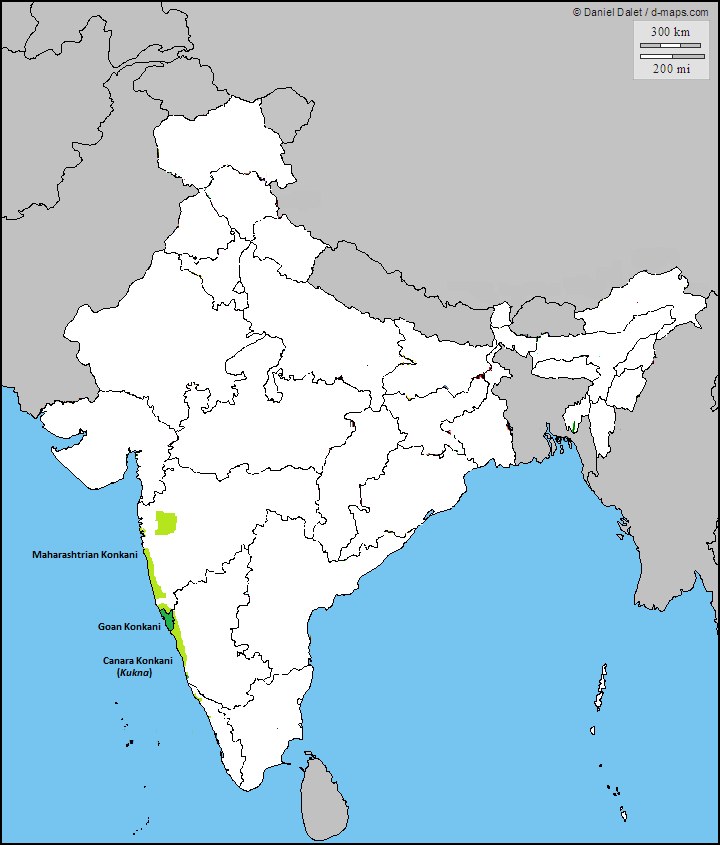
Konkani is usually grouped into four broad dialect clusters — Goan Konkani, Karnataka Konkani, Maharashtrian Konkani and Kerala Konkani — and within those, a long list of local varieties such as Antruz, Bardeskari, Saxtti (Salcete), Malvani and Chitpavani, among others. These dialects aren't always mutually intelligible, so a Konkani speaker from Goa and one from further down the Karnataka coast may struggle to follow each other's everyday speech, even though both are speaking Konkani.
Goa's Official Language
Konkani became the official language of Goa on 4 February 1987, when the Goa Legislative Assembly passed the Official Language Act. The move followed the Goa Opinion Poll of 1967, in which Goans voted to remain a separate state rather than merge into neighbouring Maharashtra, and it preceded Goa's own statehood by a matter of months — Goa became India's twenty-fifth state on 30 May 1987. Konkani was later added to the Eighth Schedule of the Indian Constitution in 1992, giving it full national recognition alongside languages like Hindi, Marathi and Bengali.
Text summarised from the Wikipedia article Konkani language, available under the CC BY-SA 4.0 licence.
Do You Know Something We're Missing?
This page will always be a work in progress. If you know a story, have an old photo, a link to a Facebook post, or a website that belongs here, we'd love to include it — with your name attached, if you'd like.
Add to This Page