
Christmas
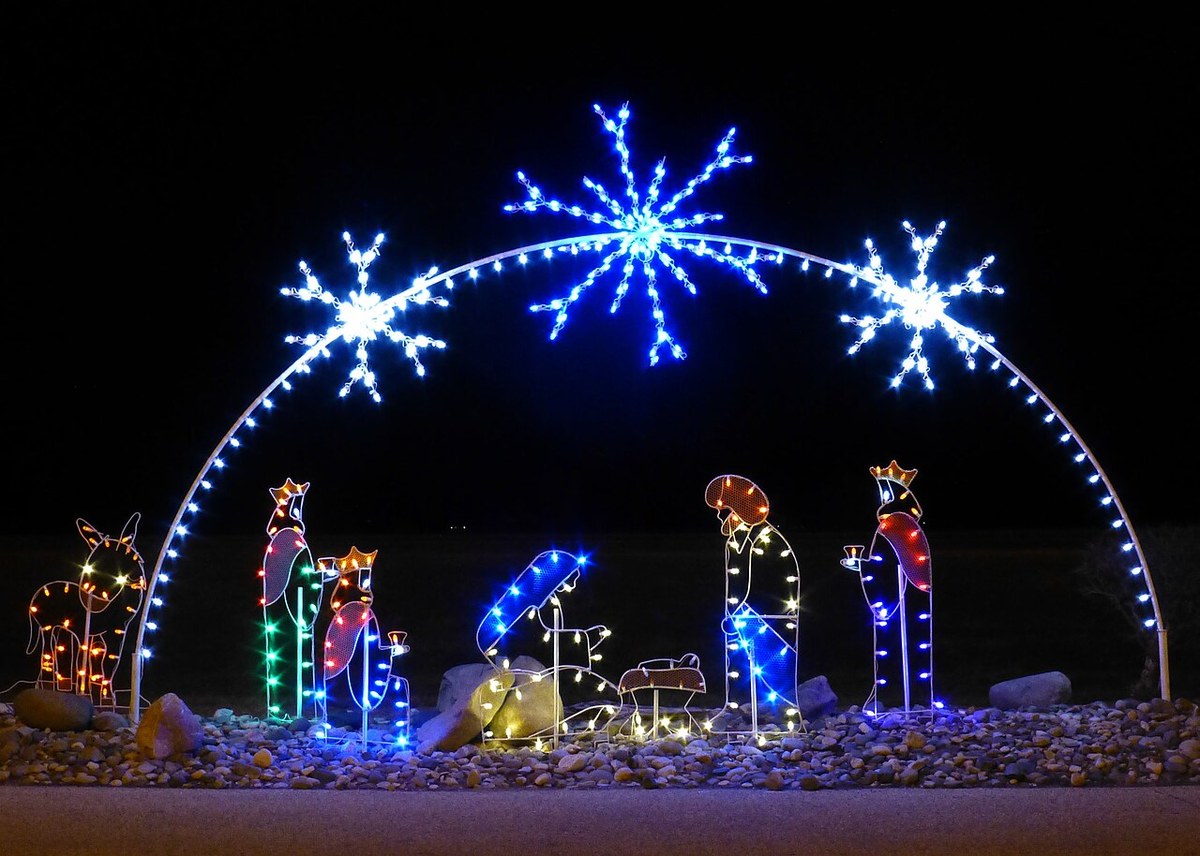
Christmas is an annual festival commemorating the birth of Jesus Christ, observed primarily on December 25 as a religious and cultural celebration among billions of people around the world. A liturgical feast central to Christianity, Christmas preparation begins on the First Sunday of Advent. Advent is followed by Christmastide, which historically in the West lasts twelve days and culminates on Twelfth Night. Christmas Day is a public holiday in many countries and is observed by a majority of Christians; it is also celebrated culturally by many non-Christians and forms an integral part of the annual holiday season. The traditional Christmas narrative recounted in the New Testament, known as the Nativity of Jesus, says that Jesus was born in Bethlehem, in accordance with messianic prophecies. When Joseph and Mary arrived in the city, the inn had no room, and so they were offered a stable where the Christ Child was soon born, with angels proclaiming this news to shepherds, who then spread the word. There are different hypotheses regarding the date of the birth of Jesus. In the early fourth century, the church fixed the date as December 25, the date of the winter solstice in the Roman Empire. It is nine months after Annunciation on March 25, also the Roman date of the spring equinox. Most Christians celebrate on December 25 in the Gregorian calendar, which has been adopted almost universally in the civil calendars used in countries throughout the world.
Origins
The English word Christmas is a shortened form of 'Christ's Mass'. The word is recorded as Crīstesmæsse in 1038 and Cristes-messe in 1131. Crīst (genitive Crīstes) is from the Koine Greek Χριστός (Khrīstos, 'Christ'), a translation of the Hebrew מָשִׁיחַ (Māšîaḥ, 'Messiah'), meaning 'anointed'; and mæsse is from the Latin missa, the celebration of the Eucharist. The form Christenmas was also used during some periods, but is now considered archaic. The term derives from Middle English Cristenmasse. Xmas is an abbreviation of Christmas, particularly in print, based on the initial letter chi (Χ) in the Greek Χριστός (Christ), although some style guides discourage its use. This abbreviation has a precedent in Middle English Χρ̄es masse (where Χρ̄ is another abbreviation of the Greek word). === Other names === The Anglo-Saxons referred to Christmas as midwinter. The period corresponding to December and January was called Gēola ('Yule'), and this term was eventually equated with Christmastide; Old English Ġeōhel-dæg ('Yule Day') was sometimes used as a name for Christmas Day. Yule or Yuil survived as the main name for Christmastide in Scotland until the modern era. A rare name for Christmas in Old English was Nātiuiteð ('Nativity'), from the Latin nātīvitās meaning 'birth'. 'Noel' (also 'Nowel' or 'Nowell', as in "The First Nowell") entered English in the late 14th century and is from the Old French noël or naël, itself ultimately from the Latin nātālis (diēs) meaning 'birth (day)'. Koleda is the traditional Slavic name for Christmas and the period from Christmas to Epiphany or, more generally, to Slavic Christmastide rituals, some dating to pre-Christian times. During the late Qing dynasty, the Shanghai News referred to Christmas by a variety of terms. In 1872, it initially called Christmas "Jesus' birthday" (Chinese: 耶穌誕日; pinyin: yēsū dànrì). However, from 1873 to 1881, the Qing dynasty used terms such as "Western countries' Winter Solstice" (Chinese: 西國冬至; pinyin: xīguó dōngzhì) and "Western peoples' Winter Solstice" (Chinese: 西人冬節; pinyin: xīrén dōngjiē); they settled on "Foreign Winter Solstice" (Chinese: 外國冬至; pinyin: wàiguó dōngzhì) in 1882. This term was gradually replaced by the now standard term "Festival of the birth of the Holy One" (Chinese: 聖誕節; pinyin: shèngdàn jiē) during the early twentieth century.
How It's Celebrated
Christmas Day is celebrated as a major festival and public holiday in countries around the world, including many whose populations are mostly non-Christian. In some non-Christian areas, periods of former colonial rule introduced the celebration (e.g. Hong Kong); in others, Christian minorities or foreign cultural influences have led populations to observe the holiday. Countries such as Japan, where Christmas is popular despite there being only a small number of Christians, have adopted many of the cultural aspects of Christmas, such as gift-giving, decorations, and Christmas trees. A similar example is in Turkey, being Muslim-majority and with a small number of Christians, where Christmas trees and decorations tend to line public streets during the festival. Many popular customs associated with Christmas developed independently of the commemoration of Jesus's birth, with some claiming that certain elements are Christianized and have origins in pre-Christian festivals that were celebrated by pagan populations who were later converted to Christianity; other scholars reject these claims and affirm that Christmas customs largely developed in a Christian context. The prevailing atmosphere of Christmas has also continually evolved since the holiday's inception, ranging from a sometimes raucous, drunken, carnival-like state in the Middle Ages, to a tamer family-oriented and children-centered theme introduced in a 19th-century transformation. The celebration of Christmas was banned on more than one occasion within certain groups, such as the Puritans and Jehovah's Witnesses (who do not celebrate birthdays in general), due to concerns that it was too unbiblical. Celtic winter herbs such as mistletoe and ivy, and the custom of kissing under a mistletoe, are common in modern Christmas celebrations in the English-speaking countries. The pre-Christian Germanic peoples—including the Anglo-Saxons and the Norse—celebrated a winter festival called Yule, held in the late December to early January period, yielding modern English yule, today used as a synonym for Christmas. In Germanic language-speaking areas, numerous elements of modern Christmas folk custom and iconography may have originated from Yule, including the Yule log, Yule boar, and the Yule goat. Often leading a ghostly procession through the sky (the Wild Hunt), the long-bearded god Odin is referred to as "the Yule one" and "Yule father" in Old Norse texts, while other gods are referred to as "Yule beings". On the other hand, as there are no reliable existing references to a Christmas log prior to the 16th century, the burning of the Christmas block may have been an early modern invention by Christians unrelated to the pagan practice. Among countries with a strong Christian tradition, a variety of Christmas celebrations have developed that incorporate regional and local cultures. For example, in eastern Europe Christmas celebrations incorporated pre-Christian traditions such as the Koleda, which shares parallels with the Christmas carol. === Church attendance === Christmas Day (inclusive of its vigil, Christmas Eve), is a Festival in the Lutheran Churches, a solemnity in the Roman Catholic Church, and a Principal Feast of the Anglican Communion. Other Christian denominations do not rank their feast days but nevertheless place importance on Christmas Eve/Christmas Day, as with other Christian feasts like Easter, Ascension Day, and Pentecost. As such, for Christians, attending a Christmas Eve or Christmas Day church service plays an important part in the recognition of the Christmas season. Christmas, along with Easter, is the period of the highest annual church attendance. A 2010 survey by LifeWay Christian Resources found that six in ten Americans attend church services during this time.
Text adapted from Wikipedia, available under the CC BY-SA 4.0 licence.